Crown Reduction
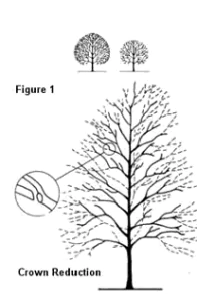
Eventually the tree’s canopy can grow to a size where they are too large for the area they inhabit. The canopy may need to be reduced to prevent damage to buildings or to clear a roadway or drive.
If you have a tree you believe needs Crown Reducing; our team are here to help.
When it comes to tree reduction, we will assess your tree first before deciding how to proceed. This will be dependent on the tree species, shape, size and condition. Our aim with tree crown reduction is to prune the tree efficiently to maintain an even balance. This ensures that the tree remains in a healthy and safe condition.
Crown reductions are carried out by pruning each individual branch back to a growth point. By doing this it prevents die back on the branch which creates unsightly deadwood. To remove the risk by using lowering ropes and slings where necessary to ensure our safety and to prevent damage to the surrounding area.
We adhere to BS3998 (British Standard) guidelines for tree pruning ensuring your tree is dealt with professionally, and in a manner you can trust. We ensure the tree’s health is not impacted whilst obtaining the desired shape.
If you need a tree Crown Reducing, please call us on 01204 592850 or email us at info@arieltreecare.com.
Get a QuoteWhat is crown reduction, and how is it safely and professionally carried out?
Crown reduction is the process of reducing the overall size of a tree’s canopy when it becomes too large for its surroundings, potentially posing a risk to buildings, roads, or driveways. The procedure involves carefully pruning individual branches back to a growth point to avoid dieback and the formation of deadwood. Before beginning, the tree is assessed based on its species, shape, size, and condition to ensure a balanced and healthy result.
Tree surgeons may use lowering ropes and slings to safely remove branches and protect the surrounding area. All work follows BS3998 (British Standard) guidelines to ensure professional and responsible tree care.
Do you offer free quotes?
Absolutely. Just get in touch with us via phone or email and we will arrange for one of our tree surgeons to visit your property and provide a quotation at no cost.
Can a tree with disease be saved?
In many cases, yes. Early diagnosis and timely treatment can help restore a tree’s health. If you notice signs of stress or illness, we recommend booking an inspection as soon as possible.
How do I know if my tree is diseased or has pests?
Look for symptoms like:
If something doesn’t look right, it’s best to call a professional to assess the tree and recommend treatment.
What if there are birds nesting?
Work is best considered after any bird activity has ceased as we are legally and morally obliged to stop work until the young have flown the nest which can be over 6 weeks.
When is the best time to prune trees?
Timing depends on the species and the purpose of pruning. It is advisable to seek professional help from a tree surgeon who can advise on the best schedule for your specific trees.
What is tree surgery, and what does a tree surgeon actually do?
Tree surgery is a specialist service within arboriculture that involves the care, maintenance, and management of trees. A tree surgeon (or arborist) is highly trained to handle tree pruning, maintenance and removal. They are also equipped to handle emergency situations and offer expert advice on all aspects of tree related matters.
My neighbour’s tree is blocking sunlight to my property – what can I do?
You are legally allowed to prune branches that overhang your boundary, but only up to the property line – you must not cut anything beyond it. Open communication with your neighbour is always advised before carrying out any work.
What if I live in a conservation area?
Again we have to seek permission to do work in the area from the local planning authority but we can do that for you. This done via a Notice of Intention application. A decision is then given by the local authority within 6 weeks.
How do I know if a tree is under a Tree Preservation Order?
Many councils provide interactive maps on their websites that you can check yourself or alternatively we can do that for you.
If my tree is protected by a TPO (Tree Preservation Order), can I still carry out any work on it?
Yes – but there are strict conditions:


If you’ve got a job you’d like us to quote for, please get in touch with a member of our qualified team today to discuss the details.
Get a Quote